
How to Perform an Agar to Agar Transfer for Mushroom Cultivation

Updated: Jul 22
Agar transfers are a cornerstone of mushroom cultivation and one of those techniques that looks more intimidating than it is. With a steady hand and a clean approach, you can move healthy mycelium to a fresh plate in minutes.
Why Transfers Matter
Refresh cultures. Agar has a finite lifespan. Mycelium will eventually exhaust the nutrients in a plate or begin to dry out. Regular transfers keep cultures active and viable.
Clean up mycelium. If contamination appears on a plate, a transfer lets you move healthy growth away from the problem, as long as you catch it early. Transfers are also how you begin isolating sectors with desirable characteristics.
Multiply plates. One healthy plate can become many. A library of clean cultures gives you a reliable starting point for every future grow.
What You'll Need
Agar plates with healthy mycelium
Fresh plate to transfer onto
Scalpel or blade
Parafilm or grafting tape to seal plates afterward
Gloves
Butane torch or alcohol lamp for flame sterilization
Step-by-Step: Agar Transfers
1. Flame sterilize your scalpel
Heat the blade with a butane torch until it glows, then let it air cool before touching agar. A hot blade will melt straight through your plate. If you're impatient, dipping the tip briefly into a clean, mycelium-free spot on the agar cools it faster.
You only need to re-sterilize between transfers to different plates or varieties, not between every cut on the same plate.
2. Identify the growth you want
Look for clean, healthy mycelium at the leading edge of growth. That's the most actively growing part of the culture and the furthest from any contamination at the center. If you're working with a contaminated plate, select growth as far from the problem as possible and work quickly.
3. Make the cut
Cut a small triangular wedge of agar beneath the target mycelium. The triangular cut is efficient: it minimizes how many times your blade contacts the agar and gives you a clean piece to work with.
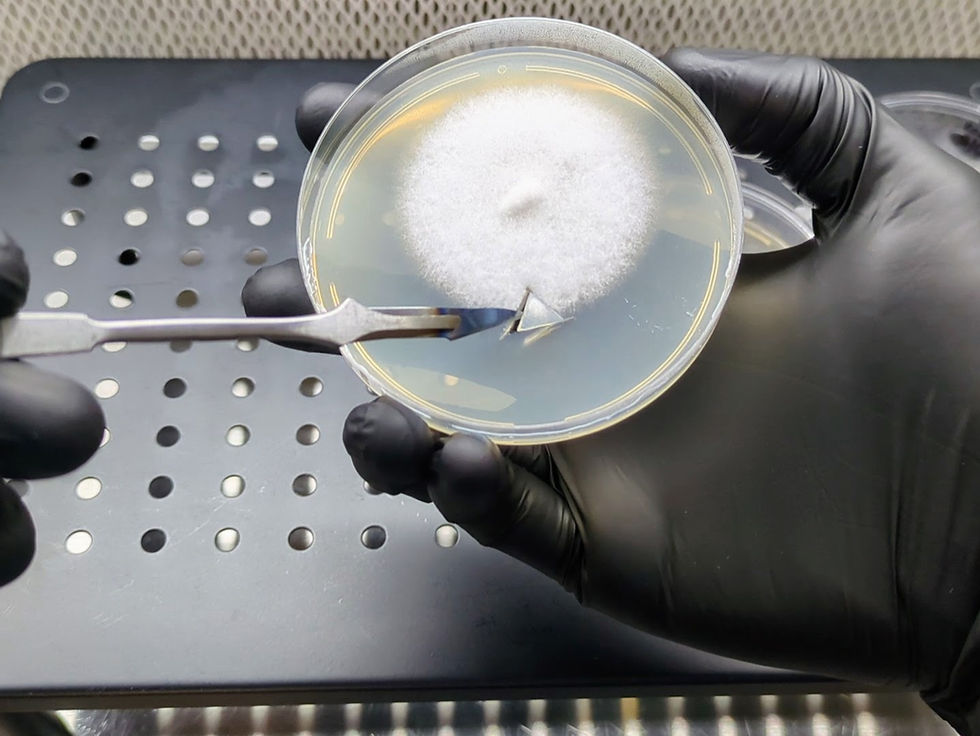
4. Lift and transfer
Gently lift the wedge with the tip of your scalpel and move it to the fresh plate. Place it flat against the surface, mycelium side down. Orientation doesn't actually matter much — the wedge will make good contact either way. What matters is picking one and sticking to it. Every decision you make in a sterile environment is attention pulled away from sterile technique, and inconsistency is how carelessness creeps in. I go face down because it fits my transfer flow. Pick whichever fits yours, then stop thinking about it.

5. Seal the plate
Close the lid and wrap with Parafilm to keep it clean.
A Note on Sterile Technique
Agar work requires a still air box or laminar flow hood. This isn't optional. Plates are open during transfers, and even brief exposure to unfiltered air introduces contamination risk. If you don't have one, we cover how to build one in the still air box guide.
Conclusion
Agar transfers feel like a barrier until you've done a few, then they become routine. Clean technique, a sharp blade, and a reliable sterile environment are all you need.
Every transfer is also an opportunity to select for stronger, cleaner growth. Over time that compounds.
Where This Fits in Your Grow
Before this: [How to Wrap Agar Plates] — sealing and storing your cultures
Next step: [How to Make Liquid Culture] — scaling a clean plate into volume
Also useful: [Still Air Box] — the sterile environment this work requires
If something's off: [Identifying and Preventing Contamination]
Transfers take practice, and practice takes plates. Our pre-poured MEA plates ship made to order, with a 0.27% contamination rate across more than 750 plates poured.


Comments