
Chaga Mushroom: The Compounds, the Sourcing, and Why Wild Harvest Matters
- Harold Evans

- Feb 11, 2025
- 4 min read
Updated: Jul 31
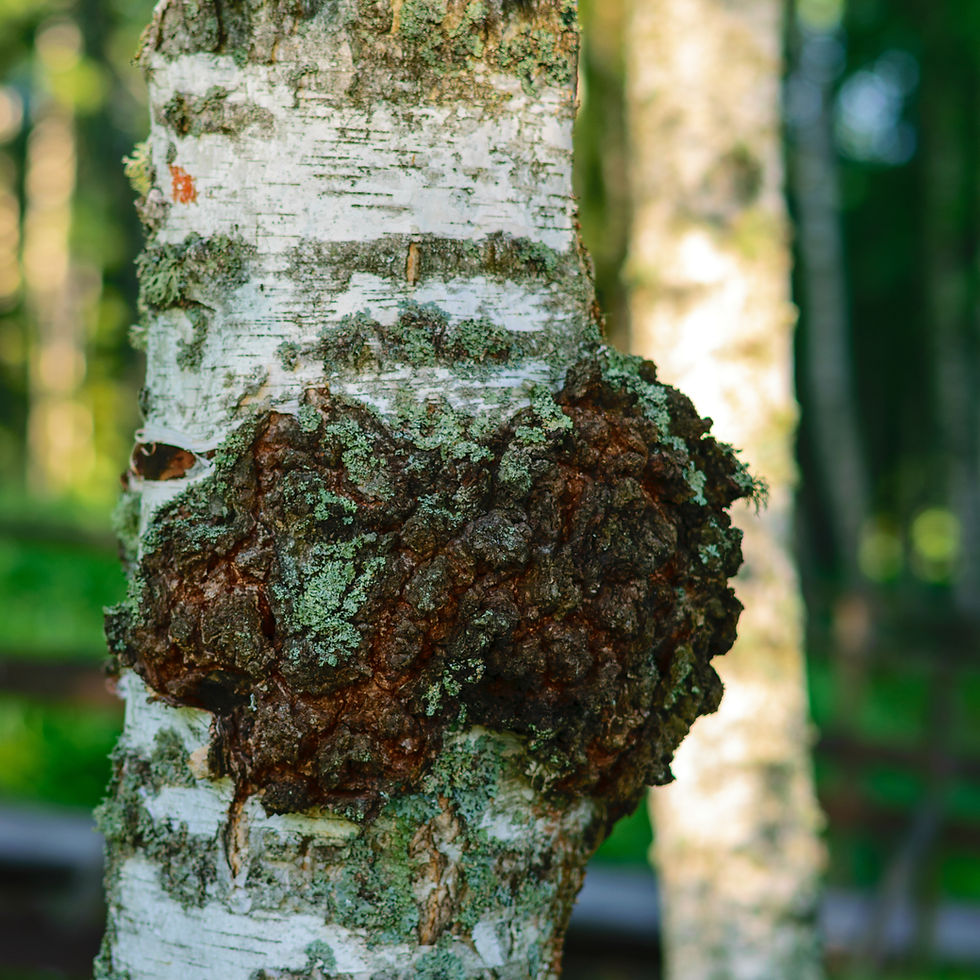
Inonotus obliquus doesn't look like a mushroom. It looks like a piece of scorched bark, a rough charcoal-black mass erupting from the side of a birch tree, sometimes growing for decades before it's harvested. Break it open and the interior is a deep, warm orange-brown, dense with compounds the fungus has been concentrating from its host for years. Chaga is a slow parasite, and that relationship with birch is what makes it chemically interesting.
It's also not cultivatable in any meaningful sense. Science has managed to grow the mycelium in controlled environments, but getting it to fruit and produce the sclerotium with the compound density that makes chaga worth using hasn't been cracked. In practice, everything sold as real chaga comes from wild harvest, which matters enormously when you're deciding where to source it.
What the Research Examines
Beta-Glucans and Immune Research
Chaga's most-studied area is its beta-glucan content and how those polysaccharides interact with immune receptors: cytokine signaling, macrophage and natural killer cell activity. A study in the International Journal of Biological Macromolecules examined chaga polysaccharides and immune-related markers (1, 2). The mechanism studied is consistent with what's described for reishi and lion's mane: modulation rather than simple stimulation.
Antioxidant Research
Chaga has one of the highest measured antioxidant profiles of any functional mushroom, driven by its polyphenol and melanin content. Studies in the Journal of Medicinal Food measured its free-radical-scavenging activity against commonly cited antioxidant sources (3). Research has also examined the melanin component in the context of gut bacteria (4). This density of antioxidant compounds is a direct product of chaga's slow parasitic growth. It has years to accumulate what faster fungi don't.
Triterpenes and Inflammatory Signaling
Chaga contains betulinic acid and other triterpenes derived from its birch host, compounds studied for their activity in inflammatory pathways. Research in the Journal of Ethnopharmacology examined chaga extracts and levels of signaling molecules including TNF-α and COX-2 (5). This triterpene profile is distinct from the beta-glucan-driven activity of other functional mushrooms, which is part of what makes chaga a separate subject of study.
Cell and Metabolic Research
Two areas of chaga's biochemistry have drawn laboratory interest beyond the immune and antioxidant work above.
The first is betulinic acid and related triterpenes, which chaga draws from its birch host. These compounds have been studied in cell-model research for how they affect cell-signaling and cell-cycle pathways, work published in the World Journal of Gastroenterology among others (6). Triterpenes are a chemically distinctive class, and chaga's birch-derived profile is part of why it's studied separately from the beta-glucan-driven fungi.
The second is chaga's activity on metabolic markers. A study in Evidence-Based Complementary and Alternative Medicine measured glucose and lipid levels in animal models given chaga extract (7). The proposed mechanism in the literature connects back to the antioxidant and anti-inflammatory activity already described, since oxidative stress affects the organs involved in metabolic regulation.
Both areas are early-stage: cell-model and animal research, not human clinical conclusions. They describe what specific studies observed under specific conditions. Anyone weighing chaga in the context of a health condition should have that conversation with their medical provider, who can account for specifics no general article can.
A Note on History
Chaga has been used in Russian and Siberian folk medicine for centuries, traditionally steeped into teas to combat fatigue and endure harsh northern winters. Siberian traditions valued it as a tonic under sustained stress, which maps reasonably onto what modern research examines around its immune-modulating and adaptogenic properties. Indigenous groups across northern Europe passed down knowledge of it as an everyday tonic long before it became a Western wellness trend.
A Note on Sourcing
Because chaga can't be cultivated to produce meaningful compound concentrations, sourcing is more consequential here than with any other functional mushroom. Demand has been growing faster than responsible harvest practices in many regions. Harvesting the sclerotium doesn't kill the mycelium, since the fungus continues growing in the tree, but sustained overharvesting drives up rarity and creates market pressure for shortcuts. Myceliated grain products labeled as chaga are already appearing, and they capture none of what makes chaga worth using.
I source my chaga from a small operation run by mycologists who harvest responsibly and understand the ecosystem they're working in. If you're buying chaga from anyone, that's the standard worth holding them to: actual field knowledge, transparent sourcing, and a supply chain that isn't outpacing the birch forests it depends on.
How to Use It
Traditional preparation involves simmering chaga into a dark, earthy tea. Break or grind it first to increase surface area, then simmer for at least 30 minutes. The result is bitter and mineral-forward, and pairs well with ginger or a small amount of sweetener.
For concentrated use, a dual-extracted tincture captures both the water-soluble polysaccharides and the alcohol-soluble triterpenes including betulinic acid. Single-extraction products leave part of the compound profile behind. As always, the quality of the source material determines the quality of the extract, which brings it back to sourcing.
References
Song, Y. et al. (2013). International Journal of Biological Macromolecules, 57, 15–22.
Cui, Y. et al. (2005). Phytotherapy Research, 19(6), 538–540.
Cha, J.Y. et al. (2018). Journal of Medicinal Food, 21(8), 786–794.
Sandvik, A. et al. (2009). Food Chemistry, 113(3), 897–902.
Park, J.H. et al. (2019). Journal of Ethnopharmacology, 236, 393–401.
Kim, Y.O. et al. (2007). World Journal of Gastroenterology, 13(4), 511–517.
Kwon, O.J. et al. (2015). Evidence-Based Complementary and Alternative Medicine, 2015, 859846.


Comments