
Cordyceps Militaris: The Compounds, the Cultivation, and What the Research Examines

Updated: Jul 21

Cordyceps militaris doesn't have a quiet origin story. In the wild, it parasitizes insects, hijacking the host's biology to fruit from its body. It's one of the stranger life strategies in the fungal kingdom, and it's part of what makes this mushroom so chemically interesting. The same adaptive mechanisms that make it a successful parasite produce compounds that researchers are still working to fully understand.
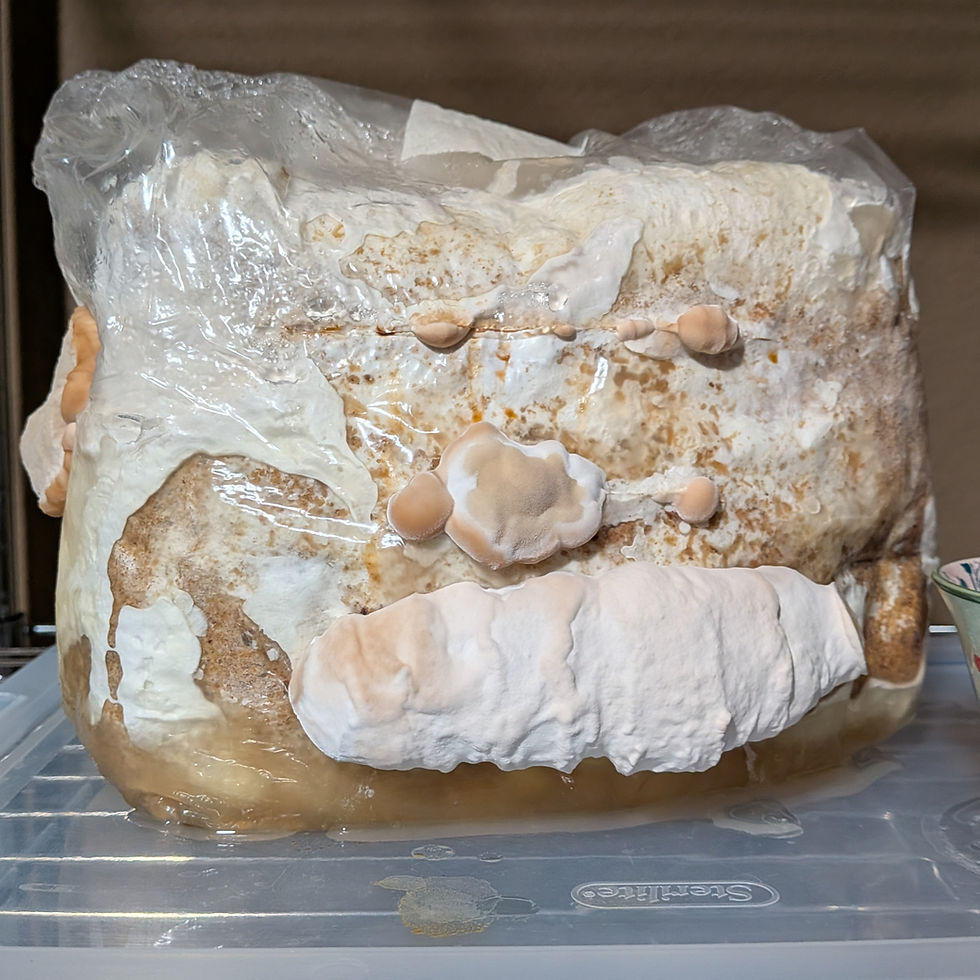
Cultivated C. militaris grows on plant-based substrates rather than insects, but its compound profile remains intact. It's one of the few functional mushrooms where modern cultivation genuinely replicates what makes the wild form notable.
What the Research Examines
Cordycepin and Cellular Energy
The most-studied compound in cordyceps is cordycepin, a nucleoside analog that has been examined for its interaction with adenosine pathways involved in ATP synthesis. Because ATP is the basic unit of cellular energy, much of the research interest centers on this pathway.
Studies in the Journal of Alternative and Complementary Medicine measured exercise performance and oxygen-utilization markers in healthy adults given cordyceps (1). Additional research has examined its relationship to fatigue measures and physical output (2). The literature characterizes the observed mechanism as metabolic rather than stimulant — no acute spike-and-crash pattern.
Oxygen Metabolism Research
Cordyceps has a long history of traditional use connected to respiration, and modern studies have examined related measures. Clinical research has looked at VO₂ max, a measure of the body's oxygen use during exertion, in the context of cordyceps supplementation (3). This is an area of particular interest in exercise and high-altitude research.
Immune Research
Like most functional mushrooms, cordyceps contains polysaccharides that have been studied for how they interact with immune receptors. Research in Phytotherapy Research examined cordyceps' interaction with macrophages and its effect on cytokine signaling (4). As with the other species, the scientific interest is in modulation, how the compounds engage the immune system, rather than simple stimulation.
Antioxidant Research
Cordyceps has been studied for antioxidant activity, driven in part by cordycepin and its polysaccharide fraction. Research has measured its free-radical-scavenging capacity and examined its effect on endogenous antioxidant enzymes, the body's own oxidative-defense proteins such as superoxide dismutase and glutathione peroxidase (5). This enzymatic angle is part of why cordyceps is studied alongside its energy-metabolism activity, since oxidative stress and cellular energy production are biochemically linked at the level of the mitochondria.
A Note on History
Cordyceps has been used in Traditional Chinese Medicine for centuries, historically reserved for emperors and elite practitioners and associated with vitality and lung function. The wild form, Cordyceps sinensis, grows parasitically on caterpillar larvae at high elevation in the Himalayas and remains one of the most expensive natural substances on earth by weight. Tibetan medicine valued it as an endurance and longevity tonic long before Western science had language for its chemistry.
Cordyceps militaris is the cultivatable species and the one behind the majority of modern research. It produces the same key compounds, particularly cordycepin, without the insect host or the price tag.
How to Use It
For concentrated use, a dual-extracted tincture captures both the water-soluble polysaccharides and the alcohol-soluble compounds like cordycepin. Each extraction method pulls different things from the mushroom — you need both for a complete extract. A product that skips one method is an incomplete extraction.
Powders and capsules are a reasonable option for convenience, though bioavailability varies significantly depending on how the material was processed. As with all functional mushrooms, avoid anything labeled "biomass" or grown on grain substrate. Grain-based mycelium products are largely starch. Fruiting body and liquid-cultured mycelium, when produced correctly, are where the active compounds concentrate.
References
Chen, S. et al. (2010). Journal of Alternative and Complementary Medicine, 16(5), 585–590.
Xiao, Y. et al. (2013). Phytotherapy Research, 27(12), 1741–1745.
Zhou, X. et al. (2009). Journal of Ethnopharmacology, 124(3), 516–519.
Paterson, R.R.M. (2008). Phytotherapy Research, 22(3), 254–260.
Yu, L. et al. (2006). Journal of Food Science, 71(9), C575–C579.


Comments