
How to Use a Pressure Canner as a Home Autoclave for Mushroom Cultivation

Updated: Jul 22

A pressure canner is the most important piece of equipment in a home cultivation setup. Without proper sterilization, grain spawn and supplemented substrates are nutrient-rich targets for bacteria and mold, contaminants that colonize faster than mycelium and don't give second chances. This guide covers how to use a pressure canner as a home autoclave, including the distinction between pressure canners and pressure cookers, sterilization times by material, and the steps that matter most for consistent results.
Pressure Canner vs Pressure Cooker
Both are used for sterilization in mushroom cultivation, but they are not the same tool. The critical threshold for sterilization is 250°F (121°C), which is only achievable at 15 PSI. A quality pressure canner is designed to reach and hold 15 PSI reliably. Many standard pressure cookers max out below that, which means longer run times and less certainty that you've actually sterilized rather than just ultra-pasteurized your material.
If your device can't confirm 15 PSI, factor that in. The Presto 23qt pressure canner is a popular and affordable option that hits 15 PSI consistently and has enough capacity for a meaningful batch. The All American is the step up for anyone producing at higher volume: metal-on-metal seal, no gasket to replace, built to last indefinitely. Either way, know your equipment and know what pressure it actually reaches.
Sterilization Times
Not all materials sterilize at the same rate. Density and volume are the main variables. The denser and larger the load, the longer it takes for heat to penetrate to the center of the material.
At 15 PSI, use these as your baseline times:
Grain jars and bags under 3 lbs: 2 hours
Bags 5 lbs and over: 2.5 hours
Hardwood substrate for gourmet species: 2.5 hours
Liquid culture: 20 to 25 minutes
Denser specialty substrates (rice-based, etc.): 90 minutes is a reasonable middle ground, but use your judgment based on volume
If your device doesn't reach 15 PSI, these times are not sufficient. Below 15 PSI you're not achieving true sterilization, you're in ultra-pasteurization territory, which is not adequate for grain or supplemented substrate.
For more on liquid culture preparation and sterilization, see the liquid culture guide.
Step 1: Inspect the Canner
Before every run, check the gasket, vent pipe, and pressure gauge for wear or blockage. A compromised gasket won't seal properly, which means inconsistent pressure and incomplete sterilization. If anything looks worn, replace it before you run a batch. Gaskets and replacement parts for most canners are cheap and widely available. There's no good reason to run a questionable seal.
Then inspect the vessel itself. Look for pitting in the metal, cracks anywhere on the body or lid, and any warping that keeps the lid from seating evenly or makes the canner wobbly. Any of those means the canner is done. Replace it, don't try to work around it.
This is the one part of cultivation where the risk isn't a failed grow. A pressure vessel with compromised structural integrity is a bomb, and it's sitting on your stove for two and a half hours at a time. Canners are not expensive relative to what happens when one fails.
If you're using a weighted gauge regulator, trust it over the dial gauge. Dial gauges drift over time and can read inaccurately without any obvious signs of damage.
Step 2: Add Water
Follow your manufacturer's recommendation as a starting point, then add a little more. Running a canner dry is a real risk on longer sterilization runs. The canner can warp and is effectively destroyed. As long as nothing is fully submerged, extra water won't hurt anything.
Place the rack inside before adding water. This keeps jars and bags off the bottom of the canner, prevents direct heat contact, and ensures steam can circulate underneath your load. If your rack sits low, elevate it a couple of inches with foil balls or spare canning lids so nothing is completely submerged.
Step 3: Load the Canner
Arrange jars or bags on the rack with enough space between them to allow even heat distribution throughout the load. Overcrowding insulates the center of your batch and prevents it from reaching sterilization temperature. If you have more material than fits comfortably, run two batches.

For jars
Wrap a piece of foil over the top of each jar and contour it firmly against the lid. This protects the filter patch from condensation dripping down during the run. Moisture saturating the filter patch can compromise its integrity and leave you with a contamination point after sterilization.
For bags
There's a lot of conventional wisdom around bags in a canner that's simply wrong. A quality PP gusseted grow bag does not melt against the side of the canner. It doesn't need to be wrapped in a towel. If your bags melt resting against the canner wall, your bags aren't good enough, full stop. The only surface that matters is the bottom, which is what your rack is for.
Here's how I load four 5lb masters mix bags, which is about the maximum a 23qt canner will take.
Pack the substrate down in the bag reasonably firmly before loading. Compaction lets you fit more in the canner and helps the bag hold its shape.

Pull the top of the bag up so it stands straight, and align the gussets so they fold together the way they would if the bag were empty. Gussets only fold one direction, so this is easier than it sounds once you've done it a few times. You should end up with a flat top section above the substrate.

Fold that flat top over the bag, wrapping the bag in its own top flap. Keep the filter patch exposed. If the patch gets covered, air can't pass through and the bag can rupture under pressure. Wrap it tightly.
The reason for the tight wrap: as the canner depressurizes, that fold pulls into a hermetic seal on its own. It means you can move bags from the canner to your workbench without worrying about air exposure in transit. It takes some practice to get consistent, but once you have it, it works every time.
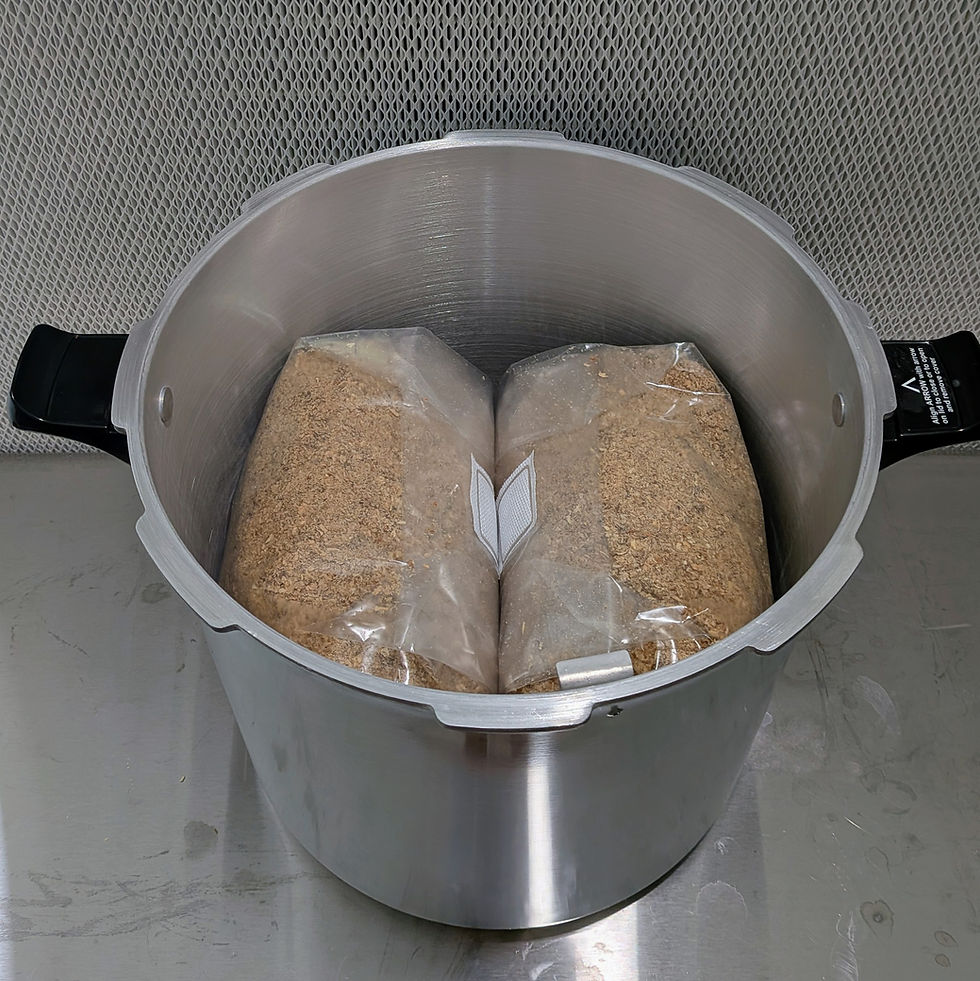
Load bags so they sit comfortably, parallel to each other, with both filter patches facing inward. A filter patch resting against the canner wall can get damaged. Patches touching water is fine, since only air passes through.
If you're stacking a second layer, run those bags perpendicular to the ones underneath. Crossing the layers keeps everything stable so nothing tips or slides during the run.
Step 4: Seal and Vent
Secure the lid and place the canner on your heat source. Turn the heat to high and leave the vent pipe open, no regulator yet. Once steam is flowing steadily from the vent, let it run for a full 10 minutes. This purges trapped air from inside the canner. Skipping or shortening this step leaves air pockets that prevent the canner from reaching accurate pressure and temperature throughout the load.
After 10 minutes of steady venting, place the weighted regulator on the vent pipe and allow pressure to build to 15 PSI.
Trust the rocker, not the gauge. A weighted regulator is a mechanical device that physically cannot lift until the pressure inside exceeds its weight, so when it starts rocking you know you're at 15 PSI. A dial gauge is an instrument that can drift out of calibration without any visible sign, and plenty of them read several PSI off. If the two disagree, the rocker is right.
Step 5: Maintain Pressure
Once the regulator is rocking steadily, reduce heat just enough to keep it rocking gently. Aggressive rocking means too much heat. It accelerates water loss and risks running the canner dry on longer runs. Start your sterilization timer once 15 PSI is reached and maintained, not before.
Keep an eye on it periodically. The goal is steady, consistent pressure for the full sterilization duration. Significant pressure fluctuations mean your material is not being sterilized uniformly.
Step 6: Cool Down
When the timer is up, turn off the heat and walk away. Do not remove the regulator or attempt to open the lid until the pressure lock drops on its own. Forcing it open early is dangerous and can cause contamination by drawing in unfiltered air as the pressure equalizes.
You'll see techniques that call for tightening lids immediately after sterilization, on the logic that it prevents air ingress during cooling. Let the canner depressurize naturally instead. Waiting until it's safe to open will never compromise your sterilization, and opening a pressurized canner to tighten anything is not worth the risk.
Cooling typically takes 30 to 60 minutes depending on load size. Larger, denser loads hold heat longer. Patience here is the same as patience in the tub. Interfering doesn't speed anything up, it just introduces risk.
Step 7: Unload and Cool to Room Temperature
Once the pressure lock drops and it's safe to open, lift the lid away from you to direct any remaining steam away from your face. Remove jars and bags carefully and set them on a clean dry surface to finish cooling.
Do not inoculate warm material. Jars and bags fresh out of the canner are still hot enough to kill your inoculant on contact. Let everything cool fully to room temperature before working with it, which typically takes several hours for larger loads. There's no reliable way to speed this up. Mushroom cultivation rewards patience, and shortcuts reliably lead to disaster. The sterilization work you just did means nothing if you inoculate too soon.
Final Thoughts
A pressure canner is one of the few pieces of equipment in home cultivation where cutting corners has immediate and obvious consequences. Get the process right — proper venting, confirmed pressure, accurate timing, and full cooldown — and sterilization becomes the most reliable step in your entire workflow. Get it wrong and nothing downstream matters.
Where This Fits in Your Grow
Next step: [How to Inoculate Grain Spawn] — working with your sterilized material
Also: [How to Make Liquid Culture] — LC sterilization specifically
And: [Choosing Grain Spawn] — what you're sterilizing and why it matters If something's off: [Identifying and Preventing Contamination]
If you'd rather skip the canner entirely, our sterilized grain bags ship made to order, ready to inoculate.


Comments