
Reishi Mushroom: What Two Thousand Years of Use and Modern Research Actually Tell Us
- Harold Evans

- Feb 4, 2025
- 4 min read
Updated: Mar 7

Reishi Mushroom: Benefits, Compounds, and the Science Behind a Long Reputation
Ganoderma lucidum has been called the mushroom of immortality for over two thousand years. That's a hard claim to live up to, and reishi doesn't try to. What it does instead is quieter and more interesting — a broad, systemic influence on immune function, inflammation, stress response, and sleep that makes it one of the most studied functional mushrooms in existence.
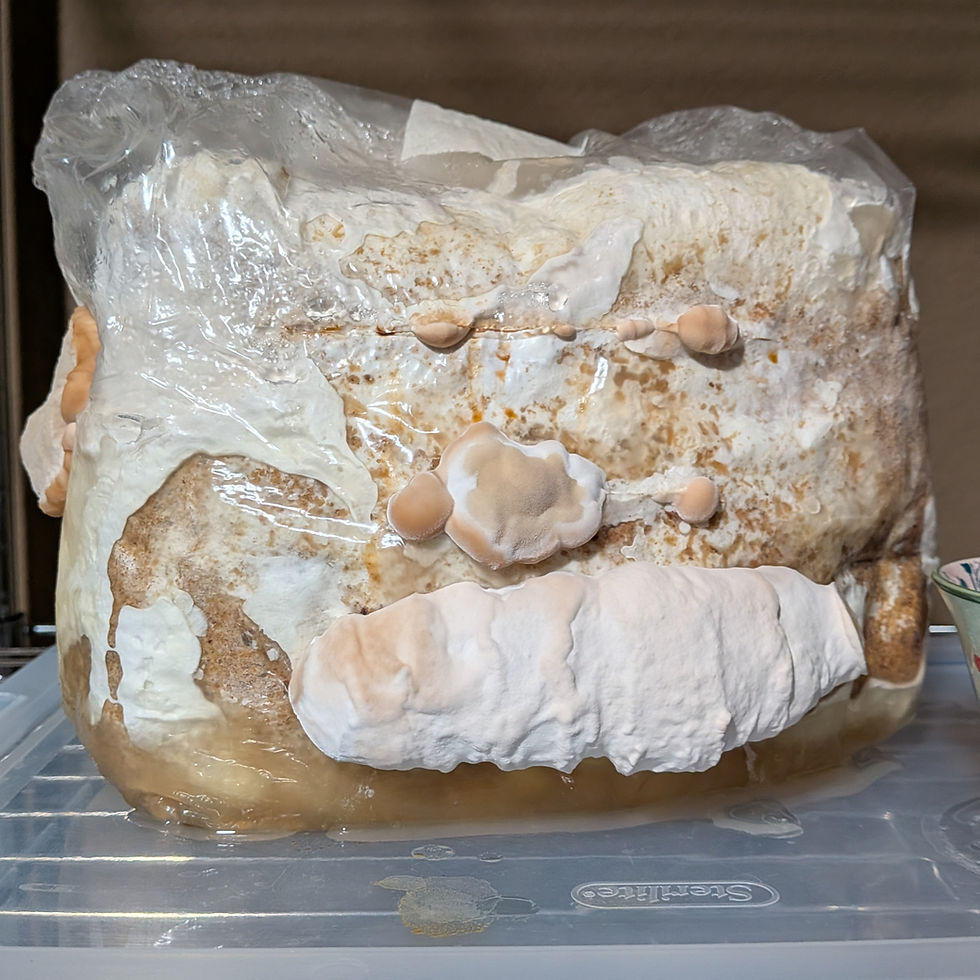
It's also one of the stranger looking ones. The classic form is a kidney-shaped cap with a lacquered, almost plastic sheen ranging from deep red to orange-brown. But grown in low-oxygen conditions indoors, reishi develops into antler formations — elongated, branching columns that never fully open into a cap. This is how I grow reishi for my tinctures. The antler form contains the same compound profile as the cap but develops differently depending on the environment, which is part of what makes reishi fascinating to cultivate. The mushroom is responsive. Change one variable and it shows you.
What Reishi May Do for You
Immune Modulation
Reishi's most well-documented property is its effect on immune function. The beta-glucans in its cell walls activate macrophages and natural killer cells, the front line of immune defense against pathogens and abnormal cells. A study in the Journal of Medicinal Food found that reishi extracts supported immune function by increasing immunoglobulin levels and improving white blood cell activity (1). Research in BMC Complementary Medicine and Therapies noted these effects may be particularly relevant for individuals with compromised immunity (2).
As with lion's mane and cordyceps, the mechanism is modulation rather than stimulation. The goal is a more calibrated immune response, not an overactive one.
Anti-Inflammatory Effects
Reishi contains ganoderic acids and other triterpenoids with measurable anti-inflammatory properties. Chronic inflammation sits underneath a long list of serious conditions — heart disease, autoimmune disorders, metabolic dysfunction. Studies in the International Journal of Molecular Sciences show reishi's triterpenes and polysaccharides can suppress inflammatory signaling pathways (3). Research in Phytotherapy Research suggests it may also help modulate cytokines, the proteins that coordinate the inflammatory response (4). This isn't anti-inflammatory in the ibuprofen sense — it's working upstream, on the signaling rather than the symptom.
Sleep Quality
This is one of the less obvious applications and one of the more interesting ones. Reishi has been used as a sleep remedy in traditional practice for centuries, and modern research offers a plausible mechanism. Compounds in reishi appear to influence serotonin production and gut microbiome balance, both of which are tied to sleep-wake regulation. Research in the Journal of Ethnopharmacology suggests reishi extracts may improve sleep quality and reduce fatigue (5), with some studies indicating a calming effect relevant to stress-related insomnia (6). The pathway runs through the gut-brain axis, which is the same reason lion's mane gut health research connects back to mood.
Antioxidant Protection
Reishi carries a significant antioxidant load, helping neutralize free radicals and reduce the oxidative stress that accumulates with age and chronic inflammation. A study in the Journal of Traditional and Complementary Medicine found reishi's antioxidant activity supports cellular health and may slow certain aspects of age-related decline (7). Ongoing research continues to examine how this protective activity intersects with cancer prevention and neuroprotection (8).
Adaptogenic and Stress Response
Reishi is one of the more well-supported adaptogens, meaning it helps the body modulate its response to physical and psychological stress through the hypothalamic-pituitary-adrenal axis. Preliminary research suggests it may help regulate cortisol over time (9). This isn't an acute effect — it's a long-game compound, which is consistent with how it's been used historically. Two thousand years of daily tonic use isn't an accident.
A Note on History
Reishi was so rare in the wild that for most of Chinese history it was accessible only to emperors and their physicians. Ancient texts describe it as a divine herb, a substance that nourished both body and spirit. In Japan it became Mannentake, the ten-thousand-year mushroom, a name that reflects the same association with longevity. Traditional preparation involved long simmering to extract its compounds into teas, which is consistent with what we now know about the water solubility of its polysaccharides.
Modern cultivation changed access entirely. What was once a symbol of imperial wealth is now widely available, though the quality of what's available varies considerably.
How to Use It
Reishi's tough, woody texture makes it unsuitable for cooking in any conventional sense. Extraction is the right approach.
A dual-extracted tincture captures both the water-soluble polysaccharides (beta-glucans, immune modulation) and the alcohol-soluble triterpenes (ganoderic acids, anti-inflammatory effects). Both matter, and you need both extraction methods to get them. A single-extraction product is a partial product.
Tea is a reasonable option for casual use — simmering dried reishi pulls the water-soluble compounds and produces a bitter, earthy brew that pairs well with ginger or honey. Powders and capsules vary widely in quality depending on how the material was processed and what substrate it was grown on.
As with all functional mushrooms, avoid biomass and grain-grown mycelium products. Fruiting body and properly cultivated liquid-culture mycelium are where the active compounds concentrate.
References
Boh, B. et al. (2007). Journal of Medicinal Food, 10(1), 1–10.
Jin, X. et al. (2016). BMC Complementary Medicine and Therapies, 16, 259.
Ahmed, F. et al. (2021). International Journal of Molecular Sciences, 22(14), 7468.
Gao, Y. et al. (2004). Phytotherapy Research, 18(10), 917–922.
Wachtel-Galor, S. et al. (2011). Journal of Ethnopharmacology, 137(3), 1121–1129.
Yuan, J. et al. (2012). Molecular Medicine Reports, 5(3), 841–845.
Chen, T. et al. (2017). Journal of Traditional and Complementary Medicine, 7(3), 231–234.
Huie, C.W., & Di, X. (2004). Journal of Chromatography B, 812(1-2), 241–257.
Szabo, A. et al. (2021). Frontiers in Psychiatry, 12, 680182.


Comments