
A Curious Tale About a Polypore


In July of 2025 I took a trip to Alaska to study the functional fungi of the final frontier. The ecology of the region has long fascinated me, and this trip saw Myco Powered ranging across the state in search of fungi worth knowing.
People ask me what makes Alaska so compelling for this work. There's a scientific answer and an honest one, and they aren't the same.
The scientific answer is genetics. Vast stretches of boreal forest, much of it old-growth and left genuinely alone, mean the fungal populations there have been doing their thing undisturbed for a very long time. Isolated populations in a harsh climate develop their own character, and that diversity is exactly what makes a region worth searching when you're hunting for cultures. You're not looking for a stronger mushroom — that's a myth. You're looking for a different one, with a history all its own.
The honest answer is that Alaska is simply, profoundly wild. A week up there teaches you something a map can't. This isn't a patch of forest ringed by highways and farmland, the way most "wilderness" tends to be down in the lower 48 — a green island in the middle of civilization. In Alaska the wild keeps going past the edge of everything. It's raw in a way that's hard to convey until you've stood in the middle of it and felt how small you are. That rawness is part of why the fungi there feel worth knowing.
I wasn't seeing it with fresh eyes alone, either. My partner, who made the trip with me, grew up in Alaska — for her this was home ground, not a destination. Watching someone move through a wild place they belong to changes how you read it, and a fair amount of what I carried home, fungi included, I owe to that.
One region in particular sharpened my focus: Denali National Park. The pristine, well-preserved landscape and higher elevation made it a promising place to look for polypores.
What is a polypore, anyway?
If I say "polypore" to most people, I get the three-headed stare. So here's the short version.
A polypore is defined by what's on its underside. Flip one over and you won't find gills like you'd see on a portobello — instead the spore-producing surface is porous, packed with hundreds of tiny pores. Those pores are the mouths of tubes, and the spores are released from inside them. That's the unifying feature, and honestly it's the only one that holds across the whole group.
What polypores look like above the pores varies a lot more than people expect. The famous ones grow as tough brackets or shelves jutting from a tree — and when that bracket form is woody and perennial, the way the red-belted is, cultivators call the fruiting body a conk. But plenty of polypores grow with a more familiar stem-and-cap shape (the black-footed polypore is a good example), and others lie flat against the wood like a crust. The shape isn't the rule. The pore surface is.
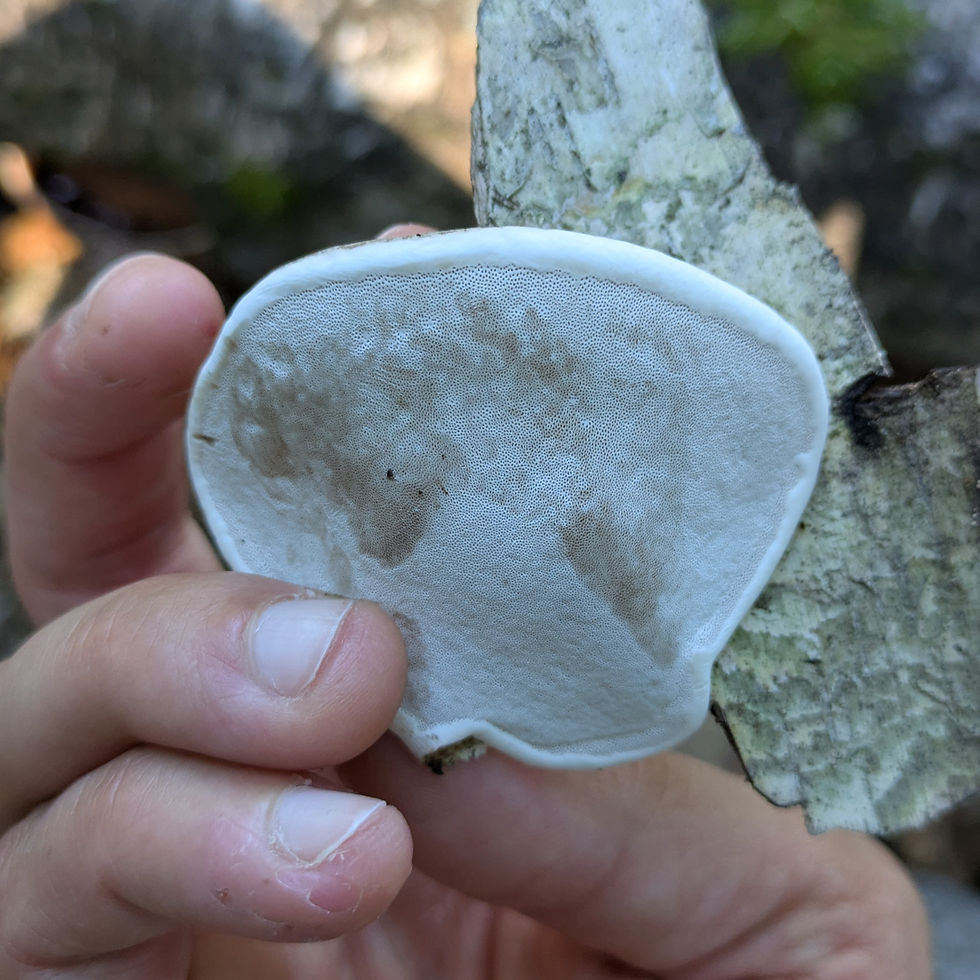
Polypores typically grow from living and downed trees, and many of them are what we call brown rot fungi. A brown rot fungus eats the cellulose and hemicellulose — the sugary scaffolding of wood — while leaving the structural lignin behind. That's why brown-rotted wood ends up looking like a pile of crumbling brown cubes. (For contrast, the white rot fungi most people have heard of, like turkey tail, do the opposite and break down the lignin.) The conk itself is tough and corky, but that texture comes from the dense fungal tissue, not from anything it's digesting.
The other thing that sets polypores apart is time. Many of them grow undisturbed for years, adding new layers season after season. That longevity demands a hardiness that would leave most gilled mushrooms — which often live and die inside a single week — in the dust.
The find

The foraging inside the park was very fruitful. I'd timed the trip around some rainy weather, because rain is when mushrooms thrive, and it paid off. I found dozens of fungi I'd never encountered, alongside a few old friends.
The one that stopped me was a specimen of the red-belted conk, Fomitopsis mounceae. It was small enough to harvest without leaving any meaningful impact on the colony — the bulk of the organism, the mycelium, lives safely inside the dead tree tissue, and it will set about growing a new conk within a season if conditions allow. I took a small tissue sample and left the rest to its work.

Eight months in the lab
When I got back to Colorado, the real work began.
I won't pretend it was quick. Polypore tissue is slow and stubborn in a way that fast growers like oysters simply aren't. A wild sample arrives carrying hitchhikers — bacteria and competing molds living right alongside the mycelium you actually want — and a slow-growing culture gives all of them time to take over a plate before your target gets established. Cleaning it up meant transfer after transfer onto fresh agar, isolating the cleanest growing edge each time and starting again, over and over, with the patience a brown-rot culture demands and the discipline to throw out anything that looked off.
After eight months of that, I had a clean, vigorous culture I could finally work with.
An experiment in adaptation
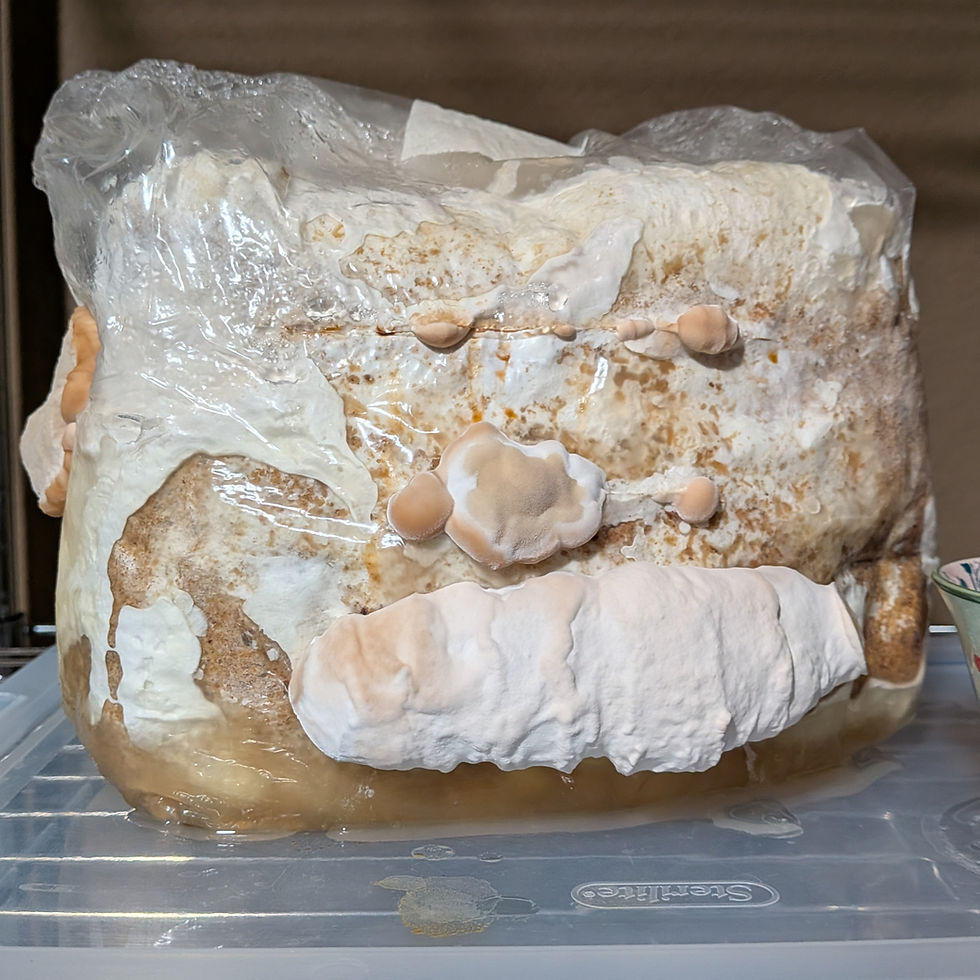
Here's the part I'm genuinely a little proud of. I fruited this clone on a substrate built mostly from hardwood pellets supplemented with oats — and F. mounceae is, in the wild, effectively a conifer specialist. A wild specimen would almost never encounter hardwood. Getting it to colonize and fruit on a non-native substrate is a real cultivation result, and an honest experiment: I wanted to see whether the genetics would express true on something the organism never evolved to eat.
So far, they have. The young conk is matching its wild parent in form and texture.
So what makes it "functional"?
This blog lives under "functional fungi," so it's worth saying what that actually means — and why I think it's a conversation worth having.
We've gotten used to thinking about health in pharmaceutical terms: something's wrong, you take a molecule built to fix it. Fungi invite a different question. Take oyster mushrooms — the same ones I sell as grow kits. They naturally contain lovastatin, the same compound family as prescription cholesterol medication, alongside beta-glucans that researchers have studied for their effects on blood sugar and lipid regulation. That's not a cure for anything, and I'm not going to pretend otherwise. But it's the kind of fact that makes you stop and reconsider what food can be. In an era where everyone's talking about GLP-1s, it's worth remembering that the natural world has been running its own pharmacology for a few hundred million years.
So where does the red-belted conk fit? Fomitopsis species have drawn real research interest for a class of compounds called lanostane-type triterpenes — the same broad family that makes reishi a subject of study. I'll be straight with you: the work on this genus is mostly preclinical, looking at things like anti-inflammatory and antimicrobial activity in the lab, and it's thinner than the research on the headline medicinals. But that's exactly what makes characterizing my own clone interesting. I want to send a sample to a lab and see what the triterpene profile of a hardwood-grown, Alaska-sourced specimen actually looks like.
One thing I'll be clear about: I won't be selling this mushroom. It came from a sample I took inside a national park, and turning that into inventory would cross a line I'm not willing to cross. This one is research and curiosity, full stop.
What's next
This is an active experiment, so I'll leave it open on purpose.
The conk you're looking at doesn't yet resemble its wild counterpart, and that's expected — it takes a long time for the fruiting body to mature and harden into the deep red belt the species is named for. It has only just begun. Over the coming months I'll be documenting it as it develops, watching for that pigment to come in, and working toward getting a sample analyzed.
A wild Alaskan polypore, cloned and fruited from tissue on the other side of the continent, on a substrate it never should have accepted. I'll keep photographing it from primordium to mature conk, and I'll share where it goes next.


Comments